


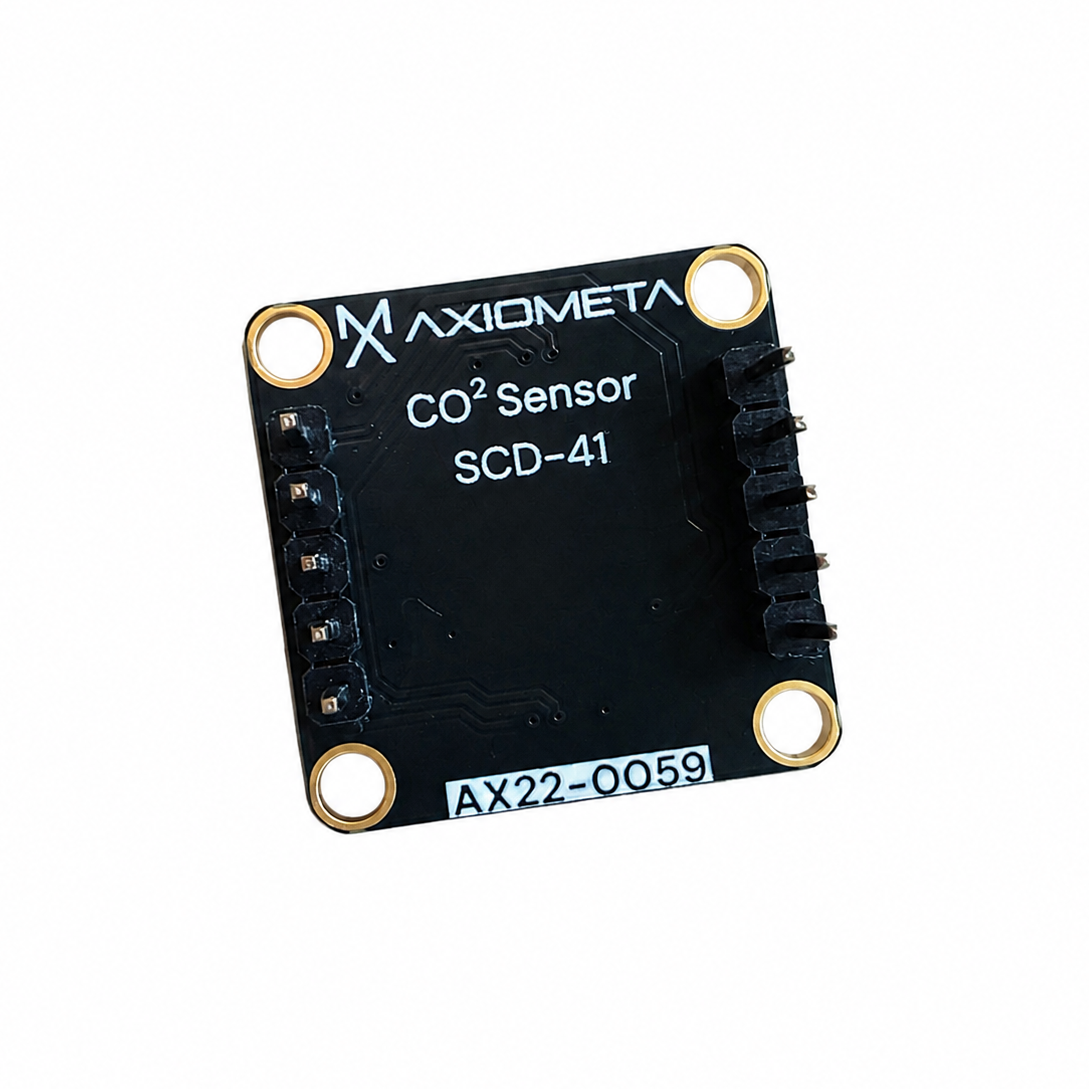
Technical details
- Sensirion SCD-41 true CO₂ sensor
- Photoacoustic NDIR, measures real CO₂, not estimated eCO₂
- 400–5,000 ppm measurement range
- ±(40 ppm + 5% of reading) accuracy
- Onboard temperature & humidity sensing
- I²C interface
- 22 mm × 22 mm square
- 4× ⌀2.7 mm Mounting Holes
- Arduino IDE Compatible
- MicroPython Compatible
- MicroBlocks Compatible
Drag to rotate
Pinout & connections


Arduino example
#include <Arduino.h>
#include <SensirionI2cScd4x.h>
#include <Wire.h>

// macro definitions
// make sure that we use the proper definition of NO_ERROR
#ifdef NO_ERROR
#undef NO_ERROR
#endif
#define NO_ERROR 0

SensirionI2cScd4x sensor;

static char errorMessage[64];
static int16_t error;

void PrintUint64(uint64_t& value) {
    Serial.print("0x");
    Serial.print((uint32_t)(value >> 32), HEX);
    Serial.print((uint32_t)(value & 0xFFFFFFFF), HEX);
}

void setup() {

    Serial.begin(115200);
    while (!Serial) {
        delay(100);
    }
    Wire.begin();
    sensor.begin(Wire, SCD41_I2C_ADDR_62);

    uint64_t serialNumber = 0;
    delay(30);
    // Ensure sensor is in clean state
    error = sensor.wakeUp();
    if (error != NO_ERROR) {
        Serial.print("Error trying to execute wakeUp(): ");
        errorToString(error, errorMessage, sizeof errorMessage);
        Serial.println(errorMessage);
    }
    error = sensor.stopPeriodicMeasurement();
    if (error != NO_ERROR) {
        Serial.print("Error trying to execute stopPeriodicMeasurement(): ");
        errorToString(error, errorMessage, sizeof errorMessage);
        Serial.println(errorMessage);
    }
    error = sensor.reinit();
    if (error != NO_ERROR) {
        Serial.print("Error trying to execute reinit(): ");
        errorToString(error, errorMessage, sizeof errorMessage);
        Serial.println(errorMessage);
    }
    // Read out information about the sensor
    error = sensor.getSerialNumber(serialNumber);
    if (error != NO_ERROR) {
        Serial.print("Error trying to execute getSerialNumber(): ");
        errorToString(error, errorMessage, sizeof errorMessage);
        Serial.println(errorMessage);
        return;
    }
    Serial.print("serial number: ");
    PrintUint64(serialNumber);
    Serial.println();
    //
    // If temperature offset and/or sensor altitude compensation
    // is required, you should call the respective functions here.
    // Check out the header file for the function definitions.
    // Start periodic measurements (5sec interval)
    error = sensor.startPeriodicMeasurement();
    if (error != NO_ERROR) {
        Serial.print("Error trying to execute startPeriodicMeasurement(): ");
        errorToString(error, errorMessage, sizeof errorMessage);
        Serial.println(errorMessage);
        return;
    }
    //
    // If low-power mode is required, switch to the low power
    // measurement function instead of the standard measurement
    // function above. Check out the header file for the definition.
    // For SCD41, you can also check out the single shot measurement example.
    //
}

void loop() {

    bool dataReady = false;
    uint16_t co2Concentration = 0;
    float temperature = 0.0;
    float relativeHumidity = 0.0;
    //
    // Slow down the sampling to 0.2Hz.
    //
    delay(5000);
    error = sensor.getDataReadyStatus(dataReady);
    if (error != NO_ERROR) {
        Serial.print("Error trying to execute getDataReadyStatus(): ");
        errorToString(error, errorMessage, sizeof errorMessage);
        Serial.println(errorMessage);
        return;
    }
    while (!dataReady) {
        delay(100);
        error = sensor.getDataReadyStatus(dataReady);
        if (error != NO_ERROR) {
            Serial.print("Error trying to execute getDataReadyStatus(): ");
            errorToString(error, errorMessage, sizeof errorMessage);
            Serial.println(errorMessage);
            return;
        }
    }
    //
    // If ambient pressure compenstation during measurement
    // is required, you should call the respective functions here.
    // Check out the header file for the function definition.
    error =
        sensor.readMeasurement(co2Concentration, temperature, relativeHumidity);
    if (error != NO_ERROR) {
        Serial.print("Error trying to execute readMeasurement(): ");
        errorToString(error, errorMessage, sizeof errorMessage);
        Serial.println(errorMessage);
        return;
    }
    //
    // Print results in physical units.
    Serial.print("CO2 concentration [ppm]: ");
    Serial.print(co2Concentration);
    Serial.println();
    Serial.print("Temperature [°C]: ");
    Serial.print(temperature);
    Serial.println();
    Serial.print("Relative Humidity [RH]: ");
    Serial.print(relativeHumidity);
    Serial.println();
}